Walk into any homewares store and it is easy to find ceramics at almost any price point, but not all of it is made the same way or made here at all. Australian Made Ceramics stand apart because of what happens well before a piece ever reaches a shelf: the clay it is shaped from, the hands that shape it, and the process it goes through to become something durable enough for everyday use.
Bendigo Pottery has been producing handcrafted ceramics Australia wide since 1858, and every step of that process still happens on site in Bendigo today.
In this blog, we will look at what separates genuinely Australian made ceramics from imported alternatives, and why that difference is worth paying attention to, whether you are buying for your own home or stocking a store.
Why Does the Victorian Clay Source Matter?
Genuine Australian-made ceramics start with genuine Australian clay, and ours at Bendigo Pottery is sourced from central Victoria, the same region that first drew our founder to Bendigo during the gold rush era. Different clay bodies behave differently once formed and fired, which is why sourcing consistent, high-quality local clay matters as much for the finished product's durability as it does for its authenticity.
Imported ceramics are often made from clay bodies and processes optimised for mass production cost, not for the specific characteristics that make a piece last. Locally sourced clay, handled by potters who understand exactly how it responds through each stage of production, produces a noticeably different result in the finished stoneware ceramics.
What Role Do Skilled Australian Potters Play?
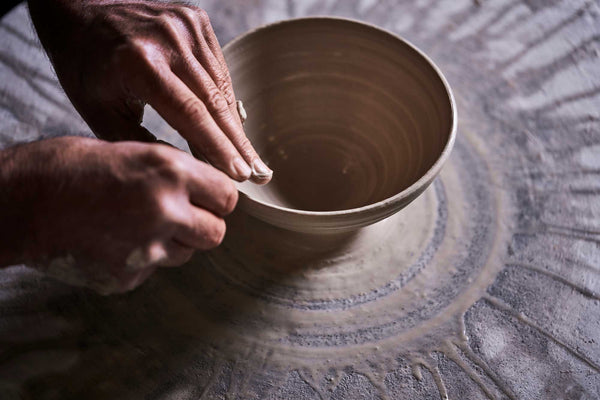
Machinery can only take a piece so far. The rest comes down to Australian craftsmanship, from wheel throwing and jollying through to trimming and texturing by hand. Every ceramic mugs Australia and ceramic bowls Australia buyer picks up has passed through the hands of a potter who understands how that specific clay body behaves at every stage, not just a mould that is repeated identically at scale.
This is where genuinely locally made ceramics separate themselves from imported lines. A skilled potter can catch and correct the small inconsistencies that come with working real clay, something a fully automated overseas production line has no way to replicate.
What Does In-House Glaze Development Involve?
Glazing is where a lot of the character in a finished piece comes from, and developing glazes in-house means the finish on every collection is genuinely our own rather than a generic supplier formula used across dozens of unrelated brands. Whether it is stoneware ceramics from our Heritage range or a more contemporary glaze in the Coupe Collection, the colour and texture are developed and tested on site before ever reaching production.
This matters just as much for consistency as it does for originality. A glaze developed and controlled in-house can be refined over time in response to how it performs in daily use, rather than being locked to whatever a third-party supplier happens to offer.
Why Does High-Temperature Firing Make a Difference?
Every piece is kiln-fired ceramics, reaching temperatures of around 1250 degrees Celsius. Firing at this temperature is what turns shaped clay into genuinely durable stoneware, hard enough for daily use rather than delicate or prone to chipping the way lower-fired or porcelain ceramics alternatives can be.
High-temperature firing also affects how well a glaze bonds to the clay body underneath it, which is part of why properly kiln-fired stoneware holds its finish and colour so much longer than cheaper, lower-fired imports.
This step is also where a lot of quality variation between suppliers actually happens, even when two products look similar on a shelf. A piece fired below the temperature genuine stoneware requires may look identical at the point of sale, but is far more likely to chip, crack or lose its glaze finish within the first year or two of everyday use, which is a cost the customer only discovers after buying.
Firing every piece in-house also means the temperature and timing of each firing can be controlled precisely and consistently, rather than relying on a third-party kiln operator working to a different standard for every supplier they fire for.
How Does This Compare to Imported Ceramics?
Imported ceramics are frequently made to a price point first and a standard second, using clay bodies, glazes and firing processes chosen for cost efficiency at scale rather than durability or craftsmanship. That does not mean every imported piece is poor quality, but it does mean the process behind it is fundamentally different to genuinely Australian-made ceramics.
For buyers who want ceramic homewares Australia households can trust to last, knowing the full production story, from clay source through to glaze and firing, gives a clearer picture than a country-of-origin label alone.
It is also worth noting that a genuine Australian made claim should hold up to this level of detail. If a supplier cannot tell you where the clay came from, who shaped the piece, or at what temperature it was fired, that is usually a sign the ceramic was finished or relabelled locally rather than actually made here from the ground up.
Asking these specific questions, rather than relying on packaging alone, is the simplest way for a buyer or retailer to tell a genuinely local product from one that only sounds like it.
Bendigo Pottery: Australia's Oldest Working Pottery
Bendigo Pottery has been handcrafting ceramics in Bendigo since 1858, making it Australia's oldest working pottery, and every piece we produce today still goes through the same fundamental process: local Victorian clay, shaped by skilled Australian potters, finished with in-house developed glazes, and fired at high temperature on site.
Conclusion
The difference between genuinely Australian made ceramics and an imported alternative is not always visible at first glance, but it shows up over years of daily use, in how well a glaze holds, how a piece withstands everyday knocks, and how it ages. Choosing ceramics made from local clay, shaped by skilled hands and properly kiln fired is choosing a piece built to last, not just one labelled to sell.
If you would like to see this process for yourself, explore our handcrafted collections online or visit Bendigo Pottery in person to watch our potters at work.
Browse Bendigo Pottery's handcrafted collections or plan a visit to see the full process firsthand.
FAQs
What makes ceramics genuinely Australian made?
Genuinely Australian made ceramics are shaped from Australian clay, formed by Australian potters, glazed with locally developed formulas, and fired on Australian soil. A product is only genuinely Australian made if every one of these steps happens locally, not just the final packaging or labelling.
Is stoneware or porcelain better for everyday ceramics?
Stoneware is generally better suited to everyday ceramics like mugs, bowls and dinnerware, since it is fired at a higher temperature and is more durable and chip-resistant than porcelain. Porcelain is thinner and more delicate, making it better suited to fine china than daily use pieces.
Why does clay source matter for ceramic quality?
The clay source affects how a piece behaves when shaped and fired, and locally sourced clay handled by potters who understand its specific properties produces a more consistent, durable result than clay bodies chosen purely for low-cost mass production.
What temperature are Australian made ceramics fired at?
Quality Australian made stoneware ceramics are typically fired at around 1250 degrees Celsius. This high-temperature firing is what makes the clay body hard and durable, and ensures the glaze bonds properly for long-term use.
How can I tell if ceramics are really made in Australia and not just finished here?
Ask the supplier directly where the clay was sourced, who shaped the piece, and at what temperature it was fired. A supplier that cannot answer these questions in detail is often only finishing or relabelling an imported product rather than making it locally from the ground up.
Do handmade Australian ceramics last longer than mass-produced ceramics?
Handmade Australian ceramics generally last longer than mass-produced imports, since skilled potters can correct inconsistencies in the clay during shaping, and high-temperature, in-house-controlled firing produces a more durable, better-bonded glaze finish.