When you choose Australian pottery for your home, you are not just picking a style - you are choosing a piece of living history. You want to know where it came from, who shaped it, and why it was made.
At Bendigo Pottery, we have been answering these questions since 1858. Founded during the gold rush in Bendigo, Victoria, we are Australia's oldest working pottery, still creating ceramics in the same town where it all began. From everyday tableware and bakeware to serving pieces, décor, and gifts, every collection carries more than 160 years of local craft and genuine pride.
This blog tells that story: where Bendigo Pottery began, how our stoneware is made by hand, and why choosing locally made ceramics still matters for modern Australian homes.

How Did Bendigo Pottery Become Part of Victorian Pottery History?
The story starts on the goldfields in the early 1850s, when a Scottish migrant named George Duncan Guthrie (1828–1910) came to Bendigo, like thousands of others, chasing gold. What he found instead was clay. A local clay deposit near Bendigo Creek turned out to be perfectly suited to pottery making.
"Here is the stuff to make pots with!" he cried.
From that single discovery, a pottery business grew out of a shack beside the creek. Within a few years, it would rival the great Staffordshire potteries of 19th-century England a remarkable achievement for a colonial enterprise in regional Victoria.
The road since then has not always been smooth. In the 1930s, Langley Ware became our most beloved range, with those distinctive brown-glazed pieces appearing in homes and cafés across Australia, having already won bronze at the 1925 British Empire Exhibition in Wembley, England. By 1949, however, the business was in serious decline. It took Bill Derham's arrival in 1968 to spark an extraordinary resurgence, and that revival has continued under the stewardship of Rod and Sally Thompson, then Raymond Laurens, and the generations of proud Bendigonians who carry George Guthrie's legacy forward today.
Six generations later, we are still here, still making Victorian pottery in Bendigo.
How Bendigo Pottery Turns Clay Into Stoneware
Every piece of handmade stoneware in Australia that we can be proud of starts with raw clay from the earth. Here is how we turn clay into the ceramics on your table.

1. Sourcing and Preparing the Clay
Different clays, each chosen for specific properties, are sourced from across central Victoria. These clays are combined with water and blended into a slip, a liquid clay mixture. To create plastic clay suitable for shaping, the slip is pumped under high pressure through a filter press to remove excess water, then pugged to eliminate air pockets before forming begins.
2. Shaping the Clay
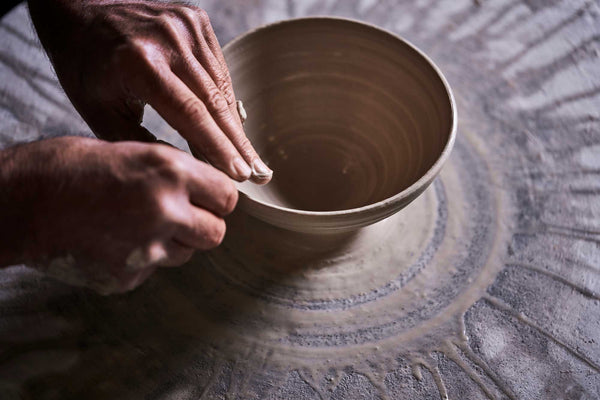
Four distinct forming methods are used depending on the piece. Some items are hand-thrown on a pottery wheel. Others are made through slip casting (slip poured into plaster moulds), jolleying (a shaping tool pushes clay into a rotating plaster mould), or pressing (clay is pressed between two plaster moulds in a hydraulic press). Each method requires skilled hands and close attention.

3. Trimming, Texturing, and Sponging
Once shaped, every piece is trimmed to remove mould seams, excess clay is cleaned away, and the surface is hand sponged to a smooth, even finish. This is also the stage where our most recognisable detail is added, a signature band of embossed circles applied using a coggle wheel. That single decorative touch has made Bendigo Pottery instantly identifiable in Australian homes for generations.
4. Bisque Firing
Dried pieces are loaded into a kiln and fired to 1000°C. This first firing makes each piece strong enough to handle and porous enough to absorb glaze. Once bisque-fired, each piece is checked before moving on to glazing, ensuring only pieces of the right strength and quality continue through the process.
5. Glazing
Glazes are mixed in-house using clays and stains to achieve a full range of colours in both satin and gloss finishes. Each bisque-fired piece is dipped into glaze, foot-wiped to remove glaze from the base so it sits cleanly on the kiln shelf, and finally stamped with our logo before the final firing.

6. Final Kiln Firing at 1250°C
Glazed pieces are loaded onto shelves inside a large natural gas-fired kiln, which is heated to 1250°C over 12 hours and then cooled for another 12 hours before it can be opened. Every single piece is individually inspected when the kiln is unloaded. What comes out is genuine Victorian-era pottery-quality stoneware built to last a lifetime.
Why Australian Pottery Still Belongs in Modern Homes
At Bendigo Pottery, our range is designed for daily life, the kind of ceramics that earn a permanent place at your table and in your kitchen.
Our current collections include the Heritage Collection, the Organic Collection, the Coupe Collection, and the Classic Collection, as well as items in our Home & Table and Gifts & Souvenirs range. Whether your home style leans towards traditional or contemporary, there is a collection that fits.
Across these collections, you will find serving bowls, plates, cups and mugs, jugs, bakeware, décor, and table accessories. Everything is 100% made in Bendigo, designed, formed, glazed, and fired locally, with no imports and no offshore mass production. The glazes themselves are developed and mixed in-house, which is how we achieve the distinctive finishes that have made our pieces recognisable across Australia for over a century.
For people looking for handmade stoneware in Australia, we offer locally made ceramics backed by more than 160 years of pottery-making history, locally sourced materials, skilled local craftspeople, and ceramics with a real story behind them.
Why Choose Bendigo Pottery for Australian Pottery?
At a time when more Australians are thinking carefully about where their everyday objects come from, here is what makes us different from every other option:
Australia's oldest working pottery: We have been making ceramics continuously since 1858 not a revival, not a rebrand. The same town, the same craft, for more than 160 years without stopping.
100% made in Bendigo: Every piece is designed, formed, glazed, and fired on site in Bendigo, Victoria. No offshore production, no imports, no shortcuts.
Clay sourced from central Victoria: We start local and stay local; even our raw materials come from the same region where our story began.
In-house glaze development: We mix our own glazes from scratch using clays and stains. The colours and finishes you see on our ceramics exist nowhere else. They are ours.
A signature you can recognise: The band of embossed circles applied with a coggle wheel has appeared on Bendigo Pottery pieces for generations. It is one of the most recognisable marks in Australian ceramics.
Award-winning heritage: Our Langley Ware range won bronze at the 1925 British Empire Exhibition in Wembley, England, recognition that our craft stood alongside the best in the world, nearly a century ago.
Hand-finished, individually inspected: Every single piece that goes into the kiln comes out individually inspected. If it does not meet our standard, it does not leave Bendigo.
Built to last a lifetime: Our stoneware is fired at 1250°C, high-temperature firing that produces dense, durable ceramics made for decades of daily use, not a season.

Conclusion
We have been making ceramics in Bendigo since 1858 through gold rushes and downturns, through decades when it would have been easier to stop. Six generations of makers have kept this going, not because it was easy, but because they believed in the work.
What we make today carries that weight quietly. It does not announce itself. A Bendigo Pottery mug does not ask to be noticed; it just shows up every morning and does its job, the way good things do.
At a time when more Australians are thinking carefully about where their everyday objects come from, the answer for us has never changed. We make everything here. We always have. And every piece that leaves our kiln inspected by hand, fired in Bendigo, made from Victorian clay carries that story with it.
When you bring one home, you are not just buying a bowl or a plate. You are choosing something real.

Frequently Asked Questions
What is Bendigo Pottery known for?
Bendigo Pottery is Australia's oldest working pottery, established in 1858 in Bendigo, Victoria. It creates Australian-made stoneware ceramics, including tableware, bakeware, and homewares all designed and manufactured in Bendigo.
When was Bendigo Pottery established?
Bendigo Pottery was established in 1858, when Scottish migrant George Duncan Guthrie (1828–1910) discovered a clay deposit near Bendigo Creek during the Bendigo gold rush and began making pottery from a shack beside the creek.
Is Bendigo Pottery Australian-made?
Yes, Bendigo Pottery is 100% Australian-made and owned. Every piece is designed, formed, glazed, and fired in Bendigo, Victoria. No products are imported.
How is Bendigo Pottery stoneware made?
Clays are sourced from central Victoria, shaped by hand throwing, slip casting, jolleying, or pressing, and then bisque-fired at 1000°C. Each piece is checked before it is glazed with in-house-mixed glazes and fired a final time at 1250°C in a natural gas kiln for 12 hours. Every piece is individually inspected after firing.
What collections does Bendigo Pottery offer?
Bendigo Pottery offers the Heritage Collection, Organic Collection, Coupe Collection, Classic Collection, Home & Table range, and Gifts & Souvenirs. Product types include serving bowls, plates, cups and mugs, jugs, bakeware, décor, and table accessories.
Is Bendigo Pottery handmade?
Some pieces are hand-thrown on a pottery wheel. Others are made using traditional methods, including slip casting, jolleying, and pressing. All pieces are hand-sponged, individually glazed, and inspected after firing.
Where can I buy Bendigo Pottery?
Shop the full range online at bendigopottery.com.au or visit the pottery in Bendigo, Victoria. Open 6 days a week (closed Tuesday), 10 am to 4 pm.